


It is sometimes called ‘the butterfly effect’: a butterfly, flapping its wings in one corner of the world can trigger a tsunami elsewhere on the planet – maybe days or weeks later. A minor, apparently trivial change can trigger an unforeseen set of consequences within the same system, and a major chain reaction further down the line. Something similar is happening in the new lineout maul law now.
World Rugby introduced a new set of wholesome-looking guidelines on June 1 2026, clarifying how referees should manage players on the ‘wrong’ side of the maul https://passport.world.rugby/laws-of-the-game/law-application-guidelines/maul-june-2026/ . The keynotes of the change were as follows:
Players must join [or rejoin] the maul by binding onto the hindmost player in the maul, not by creating a chain of two or more players and swinging up, or round, the side.
Any player bound on the outside of the maul, may contest possession with their other arm, or may continue pushing/driving on the maul, but must not be in a position to pull/drag the maul.
Once a player loses dominance and moves to be in a position to drag or pull, they should remove themselves from the contest or will be liable to sanction.
The clarification looks very clear and positive in intent. The so-called ‘horseshoe’ defence I examined in these two articles several years ago https://www.therugbysite.com/blog/breakdown/why-rugby-is-creeping-into-the-grey-area-at-ruck-and-maul and https://www.therugbysite.com/blog/set-piece/how-to-cheat-effectively-in-maul-defence had increased in popularity to the point where some teams had given up on the maul as a weapon of attack entirely. Defenders would creep up the side of the drive by stealth before encircling the ball-carrier and preventing clearance of the ball, or allowing any further forward momentum to develop. It was as invasive as a bad dose of a nasty winter virus. The ‘horseshoe’ was epidemic in its proportions and impacts.
The new maul guidelines were designed to stop defenders swinging up and around the side of the maul, or pulling or dragging opponents away from the drive, by requiring them to rejoin from behind ‘the hindmost foot’ as soon as they passed beyond the ball. The intent was to make the maul easier to referee and clearer in its outcomes, but there have been some unintended consequences along the way.
Let’s start with a quick reminder of the basic set-up on either side, as a maul forms from lineout:
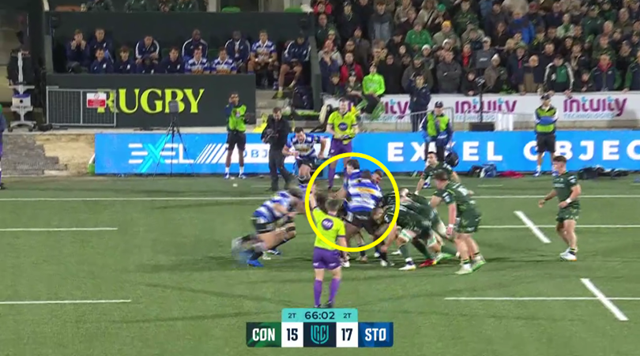
The receiver has caught the ball in the middle of the line, and as he returns to terra firma, the two lifters block access on either side of the catch by the defensive side. At the moment he comes back down to earth, the heads of both lifters are clearly visible in front of the catcher, and they will try to drive their heads further towards one another and ‘meet in the middle’, behind the receiver’s back. This situation already represents an advantage to the attacking side because there is no true contest possible for the ball.
The ideal for the maul under the new rules was crystallized in a sequence which effectively decided the fate of the RGR series at the third Test in Johannesburg:
https://t.co/0u61fDKwS7
— William Bishop (@RPvids1994) October 7, 2026
The key moment arrives when the Springboks look to ‘tack’ in search of a fresh breeze, and change the direction of the drive:
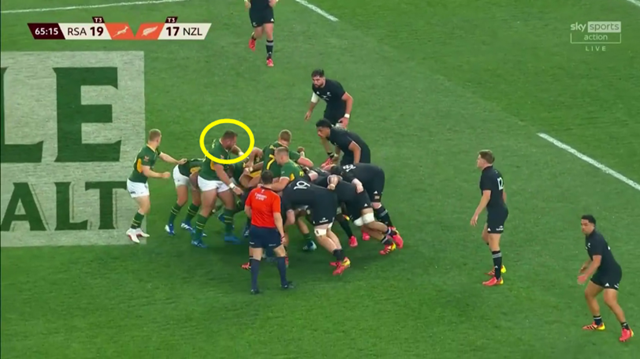
South Africa #18 clearly releases his bind and promptly rejoins the maul in front of the ball-carrier without sanction. This is part of the legalised form of obstruction that Sir Wayne Smith was bemoaning many moons ago when he said,
“I don’t like the driving maul as part of the game. There are six or seven forwards in front of the ball. There is no access to the ball. It is legalised obstruction. I would get rid of it entirely. You could do it very easily by changing the laws so that if the attacking team chooses to kick a penalty to touch inside the 22, then the other team gets the throw-in.
In this instance the change of bind was obviously illegal, and the try it helped create won the Springboks the all-important third Test.
The tendency is for new rules to be interpreted to the advantage of the attack, not the defence, even though they exist for both. They also state explicitly that players must always be in a pushing position, not dragging or pulling opponents: ‘[when] a player gets beyond the ball and/or into a pulling/dragging position, [they must] leave the maul. Referees are asked to identify, manage and/or sanction [such actions]’.
Now take a look at the following example of a recent 5m lineout drive try:
https://t.co/0rRwO3AcFs
— William Bishop (@RPvids1994) October 7, 2026
In this clip from the URC clash between Benetton [in white] and Connacht [in sky-blue] There are four clear instances of Connacht defenders being ‘pulled’ or ‘dragged’ by the Benetton forwards:
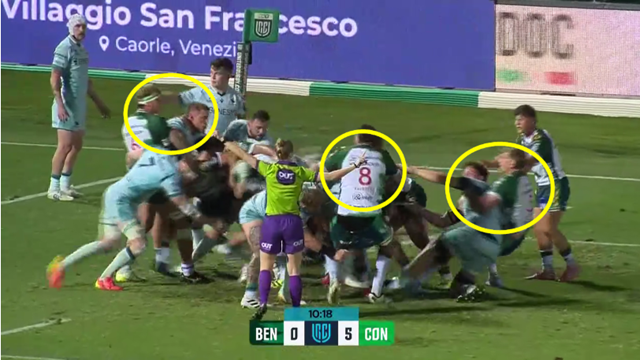
Connacht #8 Sean Jansen is pulled out of the contest for the ball by Benetton #6 at 10:15; then again by the same [unbound] player just before the touchdown.
Connacht #6 Cian Prendergast is dragged out of the back of the maul by Benetton #5 moments later.
Benetton #8 drags tight forwards Finlay Bealham and Darragh Murray out of the contest at 10:18.
The law says ‘player’, it does not say ‘defender’, and a trio of pulls or drags by attacking forwards are all clearly visible within the same snapshot of a scoring lineout drive, but play proceeds without sanction: ‘Once a player loses dominance and moves to be in a position to drag or pull, they should remove themselves from the contest or will be liable to sanction’.
Summary
The praiseworthy new guidelines intended to simplify and clarify the maul have had a ‘butterfly effect’ of tilting the balance too far in favour of the attacking side. Lifters are routinely allowed to bind slightly ahead of the receiver as the maul forms, and the new mandates to stop dragging or pulling, and rejoin behind the hindmost foot are more frequently applied as a sanction on the defensive side rather than the attack. It is already time for the guidelines to be tweaked, and balance be returned to the great maul debate.



Comments