


The Greatest Rivalry series in 2026 has been rugby’s equivalent of a game of ‘chicken’. There has been a massive clash of styles, and the three Tests so far have a told a tale of two diametrically-opposed philosophies meeting on rugby’s highway straight ahead, on a collision course. Neither has been willing to give way or abandon their principles.
Nowhere has that collision been felt more deeply in the media than at the scrum. The scrum has triggered more column inches than any other area in the series, and it led to a very public spat between Dave Rennie and ‘Rassie’ Erasmus ahead of the third Test.
The New Zealand head honcho kicked it off by implying that the Springboks did not scrum straight:
“The scrums were better tonight. I think [referee] Angus [Gardner] was pretty strong around setting a mark and trying to keep the hookers in the same spacing.
“If the Springboks moved across further left, then he stopped them. We’ll give them a bit of feedback around that.
“It’s still a bit of an issue for us because they’re able to walk around and go straight through our tight-head. So, there’ll be a couple of little technical things that we’ll share again.”
That was enough to light the touch-paper, and spark an outraged response from Rassie:
“It’s the first time in history people are talking about us walking around. Why would we all of a sudden walk around?
“Don’t come with that nonsense, and say we’re walking around and try and put those things out in the media.
“If the referees get caught up by that, then it obviously was a plan to get that message out, and we don’t want to stay quiet and just say ‘oh yeah, you’re right, we’re walking around’. We’re not f***ing walking around. We’re scrumming through.”
In the red corner, Erasmus saying the Boks are ‘scrumming through’; in the blue corner, Rennie claiming they are ‘walking around’. Both men had a point and could lay claim to a slice of the truth.
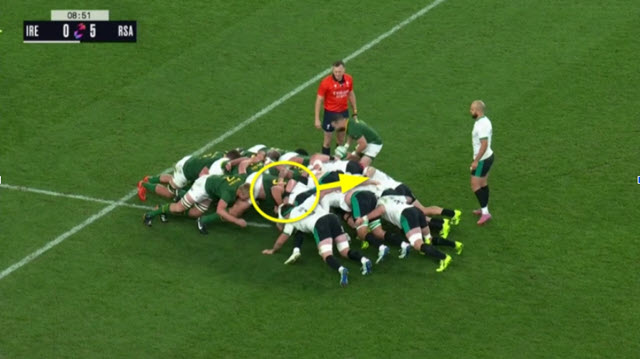
Let’s take the long view and examine the picture the Springboks want to paint at the scrum in general, and on their own feed in particular. The current era of nuclear Springbok scrum destruction probably began on a fateful evening in Dublin, on November 22, 2025. This was the first scrum of the game:
— William Bishop (@RPvids1994) November 23, 2025
South Africa’s tight-head Thomas Du Toit sets up slightly on the angle, and in towards Ireland hooker Dan Sheehan. That angle, and Du Toit’s ability to drive forward from it creates a domino effect. It means hooker Malcolm Marx can scrum underneath the point of Sheehan’s right shoulder, and between them they can lever him out of the top of the set-piece. It also frees Boan Venter on the Springbok loose-head to push the natural rotation of the scrum further around Irish #3 Tadhg Furlong. The scrum moves forward on both sides but it is also clearly travelling from right-to-left in the process.
Now let’s look at a similar scrum from the game against France, two weeks before the match in Dublin, from the overhead camera angle:
— William Bishop (@RPvids1994) September 7, 2026
The shape is the same: Du Toit is on the angle at the start, Marx erupts from directly under his opposite number’s right shoulder at the end, and Venter follows the natural rotation of the scrum around the France #3. The eagle’s eye view adds more valuable information: the Springbok back five forwards all take one short, but significant step to their left before they drive straight ahead.
It is the angle at set-up, and the sustained activity of the Springbok tight-head which triggers the movement around the corner from right to left. There is the meat of proper ‘scrumming through’ [Rassie] but there is more than just a hint of the secret sauce, the ‘walking around’ described by Dave Rennie.
The Lions had already scored a pushover try by using a similar technique in the final midweek match of the tour:
— William Bishop (@RPvids1994) August 26, 2026
Keep your eyes on the All Blacks’ tight-head prop Pasilio Tosi. The Kiwi #3 loses contact with his opposite number completely as the ‘shift left’ unfolds and the ensuing drive ahead continues unopposed. By the end, he drops to the deck facing east-west rather than north-south; split from his own hooker, and trampled underfoot in the victory march to the goal-line.
It is the same technique which the Springboks have employed ever since the beginning of the series:
— William Bishop (@RPvids1994) August 23, 2026
There is small shift to the left at ‘set’, and just enough forward movement from South African tight-head Wilco Louw to justify the swing around the corner of the scrum on the other side. Fletcher Newell finishes in the same undignified state as Tosi – high and dry and split from his mates his hooker. The Springboks ensure the shove continues until the scrum disintegrates and the ball is unplayable.
What are the solutions to the scrum paradox of ‘shifting left and scrumming through’. As long ago as their 2023 World Cup semi-final, England tried to get ahead of the right-to-left movement and stay in front of the Springbok #1 as the scrum ran sideways in the dying embers of the game:
— William Bishop (@RPvids1994) July 22, 2026
In this instance, Springbok #3 Vincent Koch is already set up at an acute angle before the ball is ever fed into the scrum, and he never moves forward thereafter. England tight-head Kyle Sinckler anticipates the right-to-left movement and crabs sideways to mirror it. England are halfway to an answer and were unlucky to be penalized.
That scrum provides the essential clue to a successful defence highlighted by a 5m scrum at Ellis Park in the first RGR Test:
— William Bishop (@RPvids1994) August 23, 2026
New Zealand hooker Asafo Aumua begins by successfully blocking Louw on the angle, so that when he starts to move it is laterally rather than straight ahead. The knock-on effect is that Marx cannot achieve the position he wants and ends up losing his battle for dominance with the All Blacks’ rake. His shoulders are above the level of Aumua’s throughout and he pops out of the roof of the set-piece first. Gerhard Steenekamp on the Springbok loose-head finishes by dragging the scrum around rather than pushing straight ahead. The picture has changed and it is ‘penalty New Zealand’.
Summary
The penalty problem at the scrum has been highlighted in indelible ink in the current RGR series. By the end of the of the third Test, the number of completed scrums had dropped to a lowly 57% and a whopping 93% of the completed scrums in the series had occurred on the New Zealand feed.
Can referees be expected to observe the nuances of subtle changes of angle and leverage and judge them in real time? Hardly. The solution? Require a feed down the middle of the tunnel as properly demanded by the lawbook, and begin with a pushing contest and no immediate strike for the ball. Forget about refereeing the angles and keep all the original binds.
Reserve sanctions for dangerous play or foul play. When the ball is touched by either hooker’s foot, ‘use it’ within three to five seconds. Return the scrum to a true contest with the reward a change of possession, rather than a penalty.



Comments